
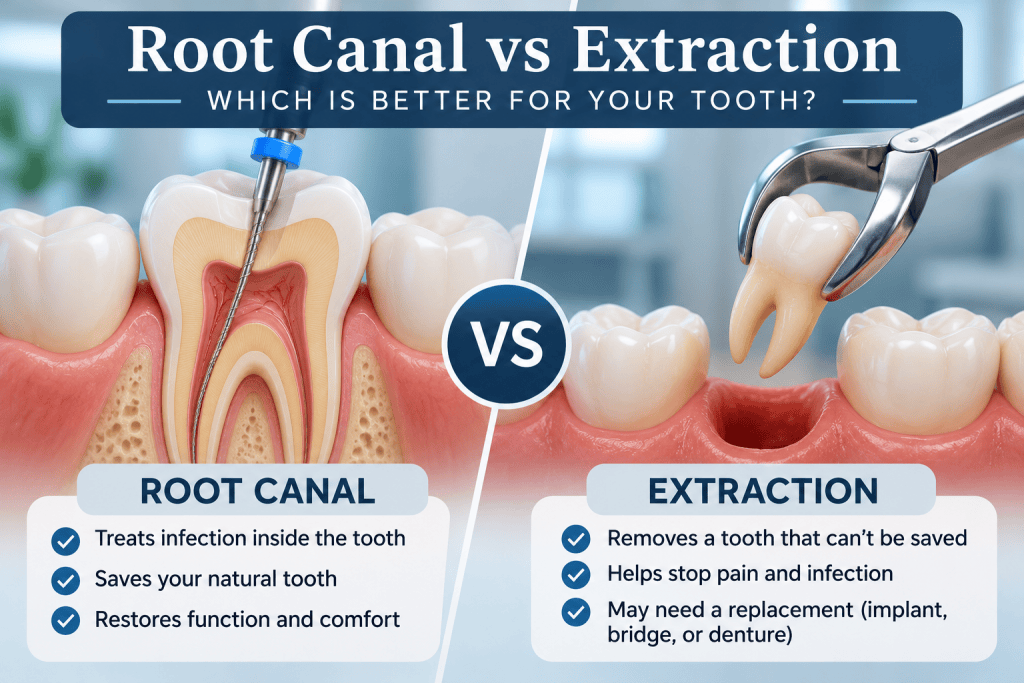
If you are comparing a root canal vs extraction in San Antonio, the most important question is whether the affected tooth can still be predictably saved.
A root canal treats infection or inflammation inside a tooth while preserving the natural tooth structure. An extraction removes the tooth completely when it is too damaged, fractured, infected, or poorly supported to restore predictably.
The short answer: if a natural tooth can be successfully treated and restored, saving it is often preferred. If the tooth cannot be predictably restored, extraction may be the better option.
At MySmile Dental in San Antonio, the decision begins with an examination, dental imaging, and an evaluation of how much healthy tooth structure remains.
Root Canal vs Extraction: What Is the Difference?
When comparing root canal vs extraction, the main difference is whether the natural tooth remains in your mouth.
During root canal treatment, infected or inflamed tissue inside the tooth is removed. The inside of the tooth is then cleaned, disinfected, filled, and sealed.
The tooth usually remains in place and may later need a restoration such as a dental crown for protection.
During an extraction, the entire tooth is removed from its socket.
If the extracted tooth needs to be replaced, options may include a dental implant, bridge, or removable restoration.
The American Association of Endodontists explains that preserving a natural tooth through root canal treatment is generally preferable when the tooth can still be successfully restored.
What Is a Root Canal?
A root canal is a dental procedure used when the pulp inside a tooth becomes inflamed, infected, or irreversibly damaged.
The pulp contains nerves, blood vessels, and connective tissue.
Damage can occur because of:
- Deep tooth decay
- A cracked tooth
- Repeated dental procedures
- Significant trauma
- An infected tooth
- A failing restoration
- Severe wear or fracture
During treatment, the affected pulp is removed and the internal spaces of the tooth are cleaned and sealed.
The American Association of Endodontists provides a detailed explanation of how root canal treatment removes infected tissue while allowing the natural tooth to remain in place.
What Is a Tooth Extraction?
A tooth extraction completely removes a tooth from the mouth.
Extraction may be necessary when a tooth cannot be predictably repaired or preserved.
Common reasons include:
- Severe decay
- A major fracture
- A crack extending too far below the gumline
- Advanced periodontal disease
- Severe loss of supporting bone
- A tooth that cannot be restored
- Certain impacted teeth
- Persistent infection when other treatment is not appropriate
Extraction is sometimes the healthiest choice.
The goal is not to save a tooth at all costs. It is to determine whether keeping the tooth provides a predictable long-term result.
If you are experiencing significant pain or swelling, MySmile Dental provides emergency dentistry in San Antonio.
When Is a Root Canal Better Than Extraction?
A root canal may be the preferred option when:
- The tooth has enough healthy structure remaining
- The root is intact
- The surrounding bone provides adequate support
- The infection can be treated
- The tooth can be restored afterward
- There is no severe vertical root fracture
- Keeping the tooth benefits the patient’s bite and function
Preserving a healthy natural tooth can help maintain normal chewing and avoids immediately creating a space that may need another restoration.
The AAE recommends considering options to preserve a natural tooth before choosing extraction when the tooth is still treatable.
When Is Extraction the Better Choice?
Extraction may be more appropriate when a tooth cannot be predictably restored.
Examples can include:
- A severe fracture extending into the root
- Extensive decay leaving insufficient tooth structure
- Advanced gum disease with major bone loss
- A non-restorable tooth
- Certain failed treatments where additional treatment is unlikely to succeed
- A tooth with a poor long-term prognosis
Your dentist should explain why the tooth is or is not considered restorable.
In some complicated cases, evaluation by an endodontist may also help determine whether the tooth can still be saved.
Root Canal vs Extraction for an Infected Tooth
An infected tooth does not automatically need to be removed.
If the tooth is structurally restorable, root canal treatment may remove the infected pulp while preserving the outside of the tooth.
However, if infection is combined with severe structural damage, a major fracture, or inadequate support, extraction may be necessary.
That is why the source of the infection and the condition of the tooth must both be evaluated.
Patients experiencing a possible dental infection should not wait for symptoms to become severe.
Learn more about emergency dental care at MySmile Dental.
Can a Root Canal Save a Cracked Tooth?
Sometimes.
It depends on how far the crack extends.
A crack that reaches the pulp may cause inflammation or infection that requires root canal treatment.
But root canal treatment does not physically repair a severe structural fracture.
If a crack extends deeply below the gumline or into the root in a way that makes the tooth unstable, extraction may still be necessary.
The exact location and depth of the crack determine whether the tooth can be restored.
Does a Root Canal Hurt?
Modern root canal treatment is performed with local anesthesia to keep the treatment area numb.
Patients often associate root canals with severe pain because the tooth may already be painful or infected before treatment begins.
The purpose of treatment is to remove the diseased tissue causing the problem.
The American Association of Endodontists notes that modern anesthesia and techniques have made root canal treatment much more comfortable than its reputation suggests.
Some tenderness afterward can occur as the surrounding tissues heal.
Does a Tooth Extraction Hurt?
Local anesthesia is also used during tooth extraction.
Patients may feel pressure during the procedure, but the area should be numb.
Post-treatment soreness varies depending on:
- Which tooth was removed
- How difficult the extraction was
- The condition of the surrounding tissues
- Whether infection was present
- Individual healing
Your dentist will provide specific postoperative instructions.
Persistent or worsening symptoms should be reported to the dental office.
Root Canal vs Extraction: Which Has the Easier Recovery?
Recovery varies from patient to patient.
After a root canal, some people experience temporary tenderness when biting or chewing.
Because the tooth remains in place, there is no extraction socket that must heal.
After extraction, the gum and bone surrounding the removed tooth need time to heal.
Patients must also protect the blood clot that forms in the socket during early healing.
The complexity of either treatment can affect recovery, so there is no universal recovery experience for every patient.
Will I Need a Crown After a Root Canal?
Many root canal-treated teeth require a final restoration to protect them.
Back teeth in particular experience significant chewing forces and may need a crown after root canal treatment.
A crown covers the visible portion of the tooth and can help protect weakened tooth structure.
MySmile Dental offers dental crowns in San Antonio for teeth that need additional protection after restorative treatment.
Not every root canal-treated tooth requires exactly the same restoration, so your dentist will recommend treatment based on the tooth involved.
Why Does a Root Canal Tooth Need Protection?
A tooth needing root canal treatment may already have lost significant structure because of decay, cracks, previous fillings, or trauma.
Removing infected pulp treats the internal problem, but the remaining tooth still needs to withstand normal chewing forces.
A restoration can help protect the tooth and restore its function.
Your dentist will evaluate how much natural tooth structure remains before choosing the final restoration.
What Happens If the Tooth Is Extracted?
Once a tooth is removed, your dentist will determine whether the space should be replaced.
Replacement may be recommended to restore chewing function, appearance, or bite stability.
Common options include:
- Dental implants
- Dental bridges
- Partial dentures
The appropriate choice depends on the location of the missing tooth, surrounding teeth, available bone, overall health, and your treatment goals.
Root Canal vs Extraction and Dental Implants
Some patients ask whether removing a damaged tooth and placing an implant is automatically better than saving the tooth with a root canal.
Not necessarily.
A dental implant is an excellent option when a tooth cannot be saved, but it is still a replacement for a missing natural tooth.
When a healthy, functional natural tooth can be predictably preserved, keeping it is generally worth considering first.
If extraction becomes necessary, dental implants in San Antonio may provide a long-term replacement option for appropriate patients.
The AAE likewise emphasizes considering tooth-preserving treatment before extraction when a natural tooth can still be successfully treated.
What Is a Dental Implant?
A dental implant is a post placed into the jawbone to replace the root portion of a missing tooth.
After the implant heals and integrates with the surrounding bone, a restoration such as a crown can be attached.
Dental implants can also support bridges or certain dentures.
Implants can be a strong replacement option, but they involve a different treatment process from preserving a natural tooth.
Can a Bridge Replace an Extracted Tooth?
Yes.
A dental bridge can replace a missing tooth by using neighboring teeth or implants for support.
Traditional bridges generally involve preparing the teeth next to the missing space for crowns.
Patients considering replacement after extraction can learn more about dental bridges at MySmile Dental.
Root Canal vs Extraction: Which Costs More?
The answer depends on the complete treatment plan.
A root canal may involve:
- Root canal treatment
- A filling or buildup
- A dental crown
An extraction may involve:
- Tooth removal
- Possible bone grafting
- A dental implant, bridge, or partial denture
- Additional appointments
Because extraction can create a need for tooth replacement, comparing only the initial procedure price does not always provide a complete picture.
Your dentist should explain the anticipated treatment sequence and associated costs before you decide.
Is Extraction Faster Than a Root Canal?
The extraction itself may sometimes be completed relatively quickly.
However, removing the tooth may create additional treatment later if the space needs to be replaced.
For example, implant treatment can involve healing time before the final restoration is completed.
A root canal preserves the existing tooth but may involve treatment followed by placement of a final restoration.
The better question is not simply which procedure is faster today.
It is which treatment provides the most appropriate long-term result for that tooth.
Can You Leave the Space Empty After Extraction?
Sometimes, but not always.
Whether a missing tooth should be replaced depends partly on its location and function.
Leaving a space may sometimes allow nearby teeth to shift or alter the way your bite functions.
Your dentist can explain whether replacement is recommended based on your particular situation.
What Happens If You Delay Treatment?
A severely infected or damaged tooth generally does not improve simply because the pain temporarily decreases.
Untreated dental problems can potentially progress and lead to:
- Increasing pain
- Swelling
- Infection
- Abscess formation
- Additional tooth damage
- Loss of the tooth
If you are experiencing severe tooth pain, swelling, fever, or signs of infection, seek professional dental evaluation promptly.
Can Antibiotics Replace a Root Canal or Extraction?
Usually not when the source of the infection is inside the tooth.
Antibiotics may sometimes be prescribed when a dental infection is spreading or causing systemic symptoms, but they do not repair decay or remove infected tissue from inside a damaged tooth.
The underlying dental problem still needs appropriate treatment.
The American Dental Association and professional dental guidance emphasize using antibiotics only when clinically appropriate rather than as a substitute for necessary dental treatment.
How Does the Dentist Decide Whether a Tooth Can Be Saved?
Your dentist may evaluate:
- How much healthy tooth structure remains
- The condition of the roots
- The location of any fracture
- Bone support
- Gum health
- The extent of decay
- The condition of previous restorations
- Whether the tooth can support a final crown or restoration
- How the tooth functions in your bite
Dental X-rays or other imaging may also be necessary.
The decision should be based on the long-term prognosis of the tooth—not simply whether it hurts today.
Image alt text: Root canal treatment compared with tooth extraction in San Antonio
Root Canal vs Extraction in San Antonio: The Short Answer
When deciding between root canal vs extraction, saving the natural tooth is often preferred when the tooth has enough healthy structure and support to be predictably restored.
A root canal treats infected or damaged tissue inside the tooth while allowing the tooth to remain in your mouth.
Extraction may be necessary when the tooth is too severely fractured, decayed, infected, or poorly supported to restore successfully.
If extraction is required, replacement options may include dental implants, bridges, or dentures.
The correct choice requires an examination and dental imaging.
Why Choose MySmile Dental in San Antonio?
MySmile Dental provides emergency and restorative dental care at 13341 San Pedro Avenue in San Antonio, Texas.
Our team evaluates the condition of the tooth before discussing whether it may be saved or needs to be removed.
Depending on your diagnosis, treatment planning may involve emergency dentistry, restorative dentistry, dental crowns, dental implants, or dental bridges.
Schedule an Evaluation in San Antonio
If you are experiencing tooth pain or have been told you may need a root canal vs extraction, schedule an evaluation before deciding to remove the tooth.
MySmile Dental can evaluate the tooth, explain whether saving it appears predictable, and discuss replacement options if extraction is necessary.
Call MySmile Dental at (210) 399-8060 to schedule your dental evaluation in San Antonio.
📍 13341 San Pedro Avenue, San Antonio, TX 78216
When possible, preserving a healthy natural tooth is worth considering—but the healthiest treatment is ultimately the one that provides a predictable long-term result.


