If you are missing a tooth, you may be trying to decide between a dental implant and a dental bridge. Both options can restore your smile and make it easier to eat and speak comfortably, but they replace a missing tooth in very different ways.
When comparing a dental implant vs bridge in San Antonio, the best choice depends on factors such as your oral health, jawbone, neighboring teeth, treatment timeline, budget, and long-term goals.
At MySmile Dental, we help San Antonio patients understand their tooth replacement options before deciding on treatment. Here is what you should know about dental implants and dental bridges.
What Is a Dental Implant?
A dental implant replaces a missing tooth from the root up.
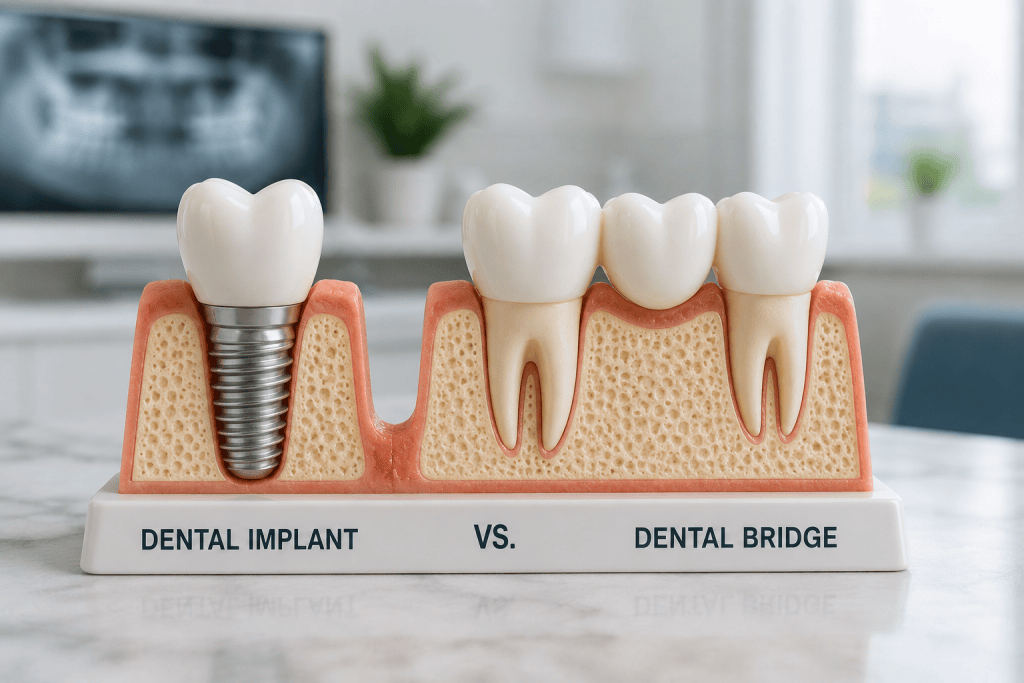
A small implant post is surgically placed into the jawbone where the natural tooth root used to be. Over time, the surrounding bone heals around the implant in a process known as osseointegration. Once the implant is stable, a custom dental crown can be attached to create a natural-looking replacement tooth.
Because the implant is supported by the jawbone, it usually does not require neighboring healthy teeth to support it.
Learn more about dental implants in San Antonio and how MySmile Dental uses them to replace missing teeth.
Dental implants can be used to replace a single missing tooth, several teeth, or to support certain full-mouth restorations.
What Is a Dental Bridge?
A dental bridge fills the space created by a missing tooth using a replacement tooth supported by nearby teeth or dental implants.
With a traditional bridge, the teeth on either side of the gap are usually prepared for dental crowns. Those crowns support the artificial tooth positioned between them.
Dental bridges can be a good option for patients who want a fixed tooth replacement but may not want or qualify for implant surgery.
MySmile Dental offers several types of dental bridges in San Antonio, including traditional, cantilever, Maryland bonded, and implant-supported bridges.
The appropriate type depends on where the missing tooth is located, the condition of the surrounding teeth, and your overall oral health.
Dental Implant vs Bridge: What Is the Main Difference?
The biggest difference between a dental implant and a bridge is how the replacement tooth is supported.
A dental implant is anchored directly into the jawbone.
A traditional dental bridge is generally supported by the natural teeth next to the missing tooth.
That difference can affect treatment time, neighboring teeth, maintenance, cost, and the overall treatment process.
Does a Dental Implant Protect the Neighboring Teeth?
One advantage of replacing a single tooth with a dental implant is that the neighboring healthy teeth usually do not need to be reshaped simply to support the replacement.
With a traditional bridge, the teeth on both sides of the gap typically need to be prepared for crowns.
However, that does not automatically mean an implant is the best option for every patient.
If the neighboring teeth already have large fillings, damage, or need crowns for other reasons, incorporating those teeth into a bridge may make sense as part of a larger restorative dentistry treatment plan.
That is why your dentist should evaluate the entire area rather than looking only at the missing tooth.
Which Option Is Better for Your Jawbone?
Dental implants have a unique advantage because the implant itself is placed within the jawbone and acts similarly to a tooth root.
When a natural tooth is lost, the bone in that area no longer receives the same stimulation it received from the tooth root.
Placing an implant gives the jawbone a new structure to support.
According to the American Dental Association, dental implants are surgically placed into the upper or lower jaw. During healing, the surrounding bone grows around the implant in a process called osseointegration.
This process creates a stable foundation for the replacement tooth.
Which Treatment Is Faster?
A dental bridge can often be completed faster than a dental implant.
A traditional bridge does not normally require the healing period needed for an implant to integrate with the jawbone.
Dental implant treatment may take several months from beginning to final restoration because the implant needs time to heal and become stable within the bone.
Some patients may also require additional treatment before implant placement depending on their bone levels and oral health.
For someone focused primarily on completing treatment quickly, a bridge may therefore have an advantage.
For someone who wants an independent replacement tooth that does not rely on neighboring teeth, the additional implant treatment time may be worthwhile.
Which Option Looks More Natural?
Both dental implants and modern dental bridges can be designed to look very natural.
The final restoration is customized to complement the shape, size, and appearance of your surrounding teeth.
With a single dental implant, the final crown stands independently rather than being connected to neighboring crowns. This can make implants especially appealing for certain visible areas of the smile.
However, the final appearance depends on much more than whether you choose an implant or bridge.
Gum health, bone levels, tooth position, your bite, and restoration design can all influence the final result.
Is It Easier to Clean a Dental Implant or Bridge?
Both dental implants and bridges require good oral hygiene.
A single implant crown can generally be brushed much like a natural tooth. Keeping the gum tissue around the implant clean is especially important.
A traditional dental bridge requires additional cleaning underneath the replacement tooth because the connected restoration does not allow regular floss to pass between the teeth in the same way.
Depending on your bridge, your dental team may recommend floss threaders, interdental brushes, a water flosser, or other cleaning tools.
Regardless of which restoration you choose, daily home care and routine dental visits are important for protecting your smile.
How Long Do Dental Implants and Bridges Last?
Both dental implants and bridges can provide many years of function when they are properly cared for.
Several factors can affect how long a restoration lasts, including:
- Oral hygiene
- Gum health
- Smoking or tobacco use
- Teeth grinding
- Bite forces
- Bone support
- The health of neighboring teeth
- Regular dental checkups
- Certain medical conditions that affect healing
Dental implants are often considered for long-term tooth replacement because the implant becomes integrated with the jawbone.
A dental bridge can also provide excellent long-term results, particularly when the supporting teeth remain healthy and the restoration is properly maintained.
No dental restoration should be considered completely maintenance-free.
Is a Dental Implant More Expensive Than a Bridge?
The initial cost of a dental implant is often higher than the cost of a traditional dental bridge, although every patient’s treatment plan is different.
Implant treatment may involve several components, including:
- Implant placement
- The implant abutment
- Dental crown
- Dental imaging
- Possible additional procedures
A traditional bridge generally involves multiple connected crowns but does not require surgically placing an implant into the jawbone.
However, comparing only the initial cost does not always provide the full picture.
It is also important to consider the condition of neighboring teeth, expected longevity, future maintenance, insurance benefits, and whether additional dental treatment may be necessary.
At MySmile Dental, we recommend comparing your complete treatment options rather than choosing solely based on the lowest initial price.
When Might a Dental Implant Be the Better Choice?
A dental implant may be worth considering when:
- You have one or more missing teeth
- Your neighboring teeth are healthy
- You want a replacement that does not rely on adjacent teeth
- You have adequate bone to support an implant or qualify for additional treatment
- Your gums and overall oral health are suitable for implant treatment
- You are comfortable with a longer treatment process
Every patient is different, which is why implant candidacy should be determined after a dental examination and appropriate imaging.
If you are interested in replacing a missing tooth, our San Antonio dental implant team can evaluate your smile and discuss your options.
When Might a Dental Bridge Be the Better Choice?
A dental bridge may be worth considering when:
- You want a fixed replacement for a missing tooth
- The neighboring teeth already need crowns
- Implant surgery may not be appropriate for you
- You prefer a treatment that may be completed more quickly
- Bone conditions could make implant treatment more complicated
- A bridge fits better into your overall restorative treatment plan
Our dental bridge services include several bridge options designed for different clinical situations.
What Happens If You Leave a Missing Tooth Untreated?
Replacing a missing tooth is not only about appearance.
Depending on the location of the missing tooth, nearby teeth may gradually shift toward the open space. Missing teeth can also affect the way your upper and lower teeth come together when you bite.
Changes can also occur in the jawbone around the area where a tooth is missing.
If you recently lost a tooth or had an extraction, discussing replacement options early can help you understand what treatments may be available before additional changes occur.
Dental Implant vs Bridge in San Antonio: Which Should You Choose?
There is no single answer that is right for every patient.
If the teeth next to the missing tooth are healthy and you want an independent replacement, a dental implant may be an excellent option.
If neighboring teeth would benefit from crowns, you want a potentially faster treatment process, or implant surgery is not the best option for you, a dental bridge may be more appropriate.
The best way to decide between a dental implant vs bridge in San Antonio is with a complete dental examination.
At MySmile Dental in San Antonio, we can evaluate your missing tooth, surrounding teeth, gums, bite, and jawbone before explaining which treatment options may work for you.
Our goal is not simply to fill the space left by a missing tooth. We want to help you choose a restoration that supports your oral health and gives you a comfortable, confident smile.
Schedule a Tooth Replacement Consultation in San Antonio
If you are deciding between a dental implant vs bridge in San Antonio, MySmile Dental can help you compare your options.
Whether you are considering dental implants, dental bridges, or another form of restorative dentistry, our team can create a treatment plan based on your individual needs.
Call MySmile Dental at (210) 399-8060 to schedule your consultation and take the next step toward replacing your missing tooth.